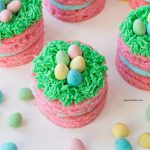
Mini Layer Cakes
Looking for a fun, colorful dessert that’s perfect for Easter or any spring celebration? These adorable mini layer cakes are exactly what you need—easy to make, bursting with bright vibes, and topped with homemade buttercream “grass” and candy eggs for that festive touch!
Servings 6
Calories 890kcal
Ingredients
For the cake
- 2 cups flour all-purpose
- 2 teaspoon baking powder
- Pinch salt
- 2 large eggs room temperature
- 2/3 cup sugar granulated
- 1 teaspoon vanilla extract
- ½ cup canola oil
- 2/3 cup + 1 Tablespoon whole milk
- ¼ teaspoon pink gel food coloring
To assemble + decorate
- 1 ½ sticks butter softened
- 3 cups powdered sugar
- 2-3 Tablespoon milk
- Kelly green gel food coloring
- Teal green gel food coloring
- Candy-covered chocolate eggs
Instructions
To make the cake
- Preheat your oven to 350°F to get it nice and hot while you prep.
- Grab a standard 13×9-inch baking sheet (or rimmed baking pan/jelly roll pan works great too) and line it with parchment paper. This simple step makes it super easy to lift out your cooled cake later—no sticking worries!
- To line it perfectly: Cut a piece of parchment slightly larger than the pan, press it in so it fits snugly into the corners, and let the excess hang over the sides like “handles” for easy removal. (Pro tip: A quick spritz of nonstick spray under the parchment helps it stay put.)
- Set your lined pan aside—you’re all set for pouring in that pretty pink batter next!
- Grab a medium-sized mixing bowl and sift together the flour, baking powder, and salt. This quick step aerates the dry ingredients for a lighter, fluffier cake texture—no lumps allowed! Set this bowl aside for now.
- In a larger mixing bowl (or the bowl of your stand mixer), beat the eggs and sugar together on medium-high speed until the mixture becomes thick, creamy, and pale in color—about 2–3 minutes. This helps incorporate air for a tender crumb.
- Next, mix in the vanilla extract and canola oil until everything is well combined and smooth.Now it’s time for the classic alternating method: Add the dry ingredients and milk to the wet mixture in batches, starting and ending with the dry ingredients (dry → milk → dry → milk → dry). Mix on low speed after each addition just until incorporated—don’t overmix, or your cake could turn tough!
- Finally, add a few drops of pink gel food coloring (gel gives the most vibrant color without thinning the batter). Beat on medium until the batter is evenly tinted a pretty pastel pink throughout—no streaks!Your beautifully colored batter is ready to pour into that parchment-lined sheet pan. Spread it evenly for uniform baking.
- Pour the pretty pink batter into your parchment-lined 13×9-inch baking sheet, then use an offset spatula or the back of a spoon to spread it out evenly into a smooth, level layer. This ensures uniform baking and makes cutting perfect circles easier later!
- Pop the pan into your preheated 350°F oven and bake for about 15 minutes, or until the top springs back lightly when touched and a toothpick inserted in the center comes out clean (or with just a few moist crumbs—no wet batter!). Keep an eye on it starting around 12 minutes, as oven times can vary.
- Once done, remove the cake from the oven and let it cool completely in the pan on a wire rack—this usually takes 30–60 minutes, but you can speed things up by transferring the whole sheet (with parchment handles) to the rack for better airflow. Full cooling is key to clean cuts and no crumbling!
- When the cake is totally cool, grab your round cookie cutter (about 2–3 inches works great for mini cakes) and cut out 12 circles—this will give you enough for six two-layer minis. Press straight down firmly without twisting to get sharp edges, and arrange the circles on a cutting board or parchment as you go. (Any scraps? Save them for snacking or crumbling into trifle!)
- Carefully transfer your 12 pink cake circles to a wire cooling rack (or a parchment-lined tray) so they stay flat and cool evenly if needed.
- Now, whip up your teal buttercream frosting (or refresh it if already made): Start with your favorite vanilla buttercream base, then gradually add teal gel food coloring a drop or two at a time. Gel coloring gives the most intense, vibrant hue without watering down the frosting—mix thoroughly until you reach that gorgeous, springy teal shade perfect for piping “grass.” (Pro tip: Use a spatula to scrape the sides and ensure even color distribution.)
- Scoop your vibrant teal buttercream frosting into a piping bag fitted with a round piping tip (Wilton #10 is perfect for smooth, even dollops or a simple base layer—its medium size gives great control without being too fine).
- Start by frosting 6 of your pink cake circles—these will be the bottoms of your mini layer cakes. Pipe a generous, even layer of teal buttercream right in the center, then spread or swirl it outward to cover the top completely, leaving a little border if you like for a clean look.
- To build each mini cake: Take one of the remaining unfrosted cake circles and gently place it on top of a frosted base, pressing down lightly so it adheres without squishing the frosting too much. The result is a cute two-layer mini with a hidden surprise of teal frosting in the middle!
- Tint your remaining buttercream (or prepare a fresh batch of vanilla buttercream) with green gel food coloring. Start with a small amount and add more gradually until you get that fresh, vibrant spring green—gel coloring delivers bold color without altering the frosting’s texture.
- Scoop the green buttercream into a piping bag fitted with the Wilton #233 multi-opening tip (the classic grass tip—its multiple small holes create perfect strands of “grass” with just a squeeze!).
- Holding the bag straight up and perpendicular to the top of each mini layer cake, pipe short bursts of frosting all over the surface. Squeeze, pull up slightly, and release to form little grassy tufts—cover the entire top evenly for a lush, textured look. It might take a little practice on a scrap of parchment first, but you’ll get the hang of it quickly!
- Place 4–5 colorful candied eggs (or mini jelly beans, chocolate eggs, or pastel sprinkles) right on top of the green “grass” frosting on each little cake. Arrange them in a cute cluster or nest-like pattern for that extra Easter charm—they add the perfect pop of color and whimsy!
- Serve immediately and watch them disappear—whether at your Easter brunch, family gathering, or just as a fun spring treat. These bite-sized beauties are as delightful to look at as they are to eat!
Nutrition
Calories: 890kcal | Carbohydrates: 117g | Protein: 8g | Fat: 45g | Saturated Fat: 17g | Cholesterol: 134mg | Sodium: 247mg | Potassium: 290mg | Fiber: 1g | Sugar: 83g | Vitamin A: 855IU | Calcium: 134mg | Iron: 2.4mg
